
TLDR: A final push can be surprisingly productive, but achieving an outcome isn’t the same as having the time to fully experience it.
CAVEAT: You can do a final push and slow down for a fuller experience.
(As always, find your next step at the end!)
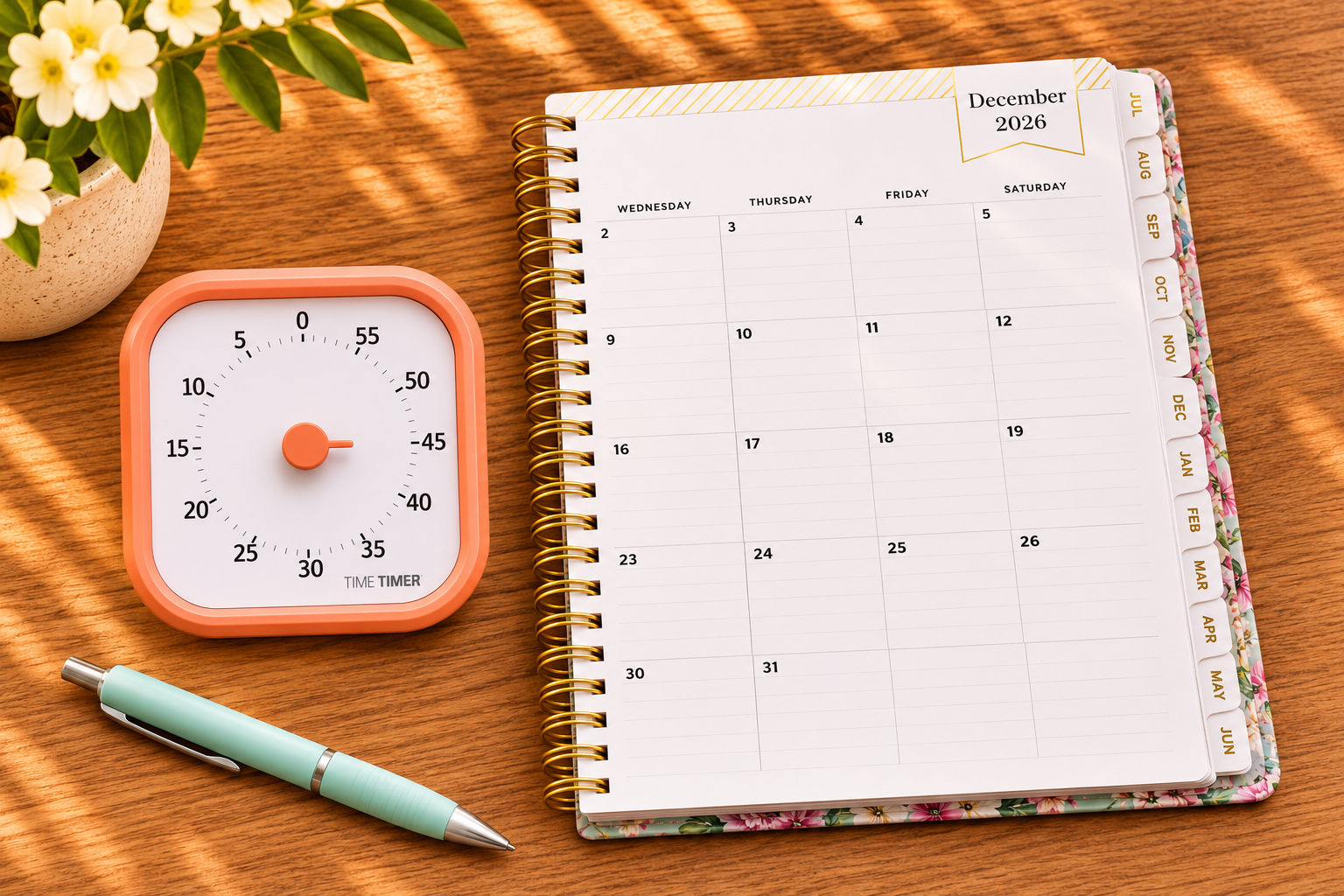
They’re here—the final six weeks of 2026, when the pressure surrounding end-of-year goals starts competing with the holiday rush.
For some people, the heavy competitor is the holiday rush. For others, it’s the getting close to a finish line on whatever they expected to do with their year.
For a lot of us, it’s both.
Our calendars start filling up with additional holiday duties and desires as our subconscious becomes keenly aware that we’re nearing a deadline.
Maybe you’re a New Year’s Goals person or maybe you’re not (I’m not, but perhaps I’m too rebellious to take advantage of ‘fresh start’ energy.) Either way, we’re all subject to the same calendar: January 1st through December 31st. With that comes a collective feeling that one time period is closing and another is beginning—whether or not our personal lives neatly divide themselves that way.
So even without having set specific goals eleven months ago, you might be feeling a sense of internal pressure to hurry up and get something done, if only so you can prevent that something from chasing you into next year.
There’s nothing wrong with wanting to clear away the old to make room for the new.
And there can actually be benefits to working under time pressure. That’s part of why “five minutes matters” is such a helpful mantra. It not only reminds you that small acts of consistency build up over time, but it also creates a little bit of urgency under whatever you’re doing.
When you use a five minute timer to, for example, get the room tidied up, you might find yourself naturally leaning into the relay race effect and upping your speed as the clock ticks down.
Time pressure can be a good productivity tool.
What matters is how you use that pressure.
Outcome Versus Experience
Time pressure, whether it’s a five minute timer or the last six weeks of a year, can help us focus in on what we’re trying to accomplish.
One of the other reasons people say “five minutes matters” is that time pressure helps you overcome inertia. When you’re facing down a messy room (or any obstacle that makes you feel dread instead of excitement) it can be paralyzing. Those are the times when we might find ourselves scrolling the internet for half an hour after searching “how to get started” rather than just … getting started.
Setting a timer performs some sort of mental magic trick that I’m not an adept enough magician to explain in scientific terms. But I know that the express permission it gives you to just do a little bit and be done usually kicks your brain into momentum mode. The same thing can happen with larger chunks of time.
Realizing you only have a certain amount of time left can help you focus your attention and get a surprising amount done.
I learned this lesson long before I got (obsessed?) with home management and productivity.
In high school, I had a wonderful history teacher who kept me coming to class by creating a customized work plan for me.
Our sessions were sixty minutes long with a warning bell that rang ten minutes before the end of class. This teacher kindly considered my apparent focus issues and allowed me to float the room, helping other students with their work until the warning bell rang. Then I had ten minutes to complete my own assignment.
I love reading and, as you know, writing. Being able to cram both of those activities into ten tight minutes resulted in my regular attendance and an A in the class (which definitely could not be said about my other classes).
Mr. Jimenez, if you ever read this, thank you for your adaptability, your understanding, and for finding a way to keep me engaged when it would have been so much easier to write me off.
But don’t let my story fool you. Getting something done with limited time doesn’t always mean we gave ourselves the time to truly experience it.
This worked in my high school example because the goal (to be honest) was to keep me coming to class. The individual assignments were a means to an end, not the whole point of the experience.
But in other situations, the endeavor is the point. And if we push ourselves to rush through for the sake of meeting an arbitrary deadline (like January 1st) we’re cheating ourselves out of a deeper experience.
Determine Your Desired Depth
When it comes to productivity, there are different levels of depth that depend on both your project and what you want to get out of your project.
The project itself might be “deep.” In other words, it might be layered in its complexity, requiring a large number of steps and careful mapping out of when those steps need to happen.
But really, when we talk about depth we’re talking about how deep you want your experience of the project to be.
Making this evaluation is highly subjective and shouldn’t be held to anyone else’s standards.
You might not feel like planning a big project is that important, because it’s something you have the chance to do regularly. Or you might desire a slow, rich experience even when the project is mundane and technically small.
For example, you might have a big holiday party that you’re responsible for putting on. But maybe you don’t really want to spend an exorbitant amount of time planning the details if a few quick sessions can ensure that key people get invited and the food order is covered.
Or perhaps your project is choosing your next planner. Maybe you want the time to visit a few different stores because you deeply enjoy slowly walking the aisles, comparing the various layouts and selecting new pens. You’re allowed to want the experience that you want.
And you’re allowed to make time for it.
The size of the project doesn’t determine how much time you should give it—your desired depth of experience does.
Balance Busy With Being Present
I know, I know. “Be present” is advice that’s so generic it’s become an easy to ignore cliche. But we still need to find a way to do it, or we’ll find another December blowing by without our awareness.
If you’re a person who loves the end of year rush, I won’t tell you to slow down to be more present. And if you’re a naturally slower person (like I am) I won’t say that you need to do things you find unappealing just to “make memories”.
Instead, I’ll say this:
Being present means intentionally deciding how you’ll use your time.
Of course, the ideal would be doing this all year, but it’s especially important to remind ourselves of this during seasons when internal desires are competing with external demands.
Because I’ll be the first to admit what might be considered shameful: I have to consciously remind myself that spending quality time with my family is more important than the physical environment we’re doing it in (I don’t apologize for my inner minimalist, but I also sometimes feel sorry about her strong preferences). That means intentionally deciding between attacking my next decluttering project and sitting quietly to watch my son play in a mess that he’s clearly enjoying.
So be intentional about what you do with your time this month—you won’t have another chance to be here, now.
Ideas For A Final Push (That Won’t Push You to Your Limit)
When you’re trying to balance the internal and external pressures we feel at this time of year, it’s important to recognize that you can only expend so much energy in a given timeframe without pushing yourself to or beyond your limit. So it’s not really about “only” having six weeks left in the year:
It’s about distributing your energy to get the most out of the time that exists.
A quick energy audit is a great way to assess which projects you should actually consider doing with the rest of your year.
You can do an energy audit by asking yourself how much a given project will “take out of you” versus how much it will fill you up. Some projects are naturally more energy demanding than others, so considering that can help you map out the rest of your year in a way that will leave you feeling successful, rather than drained.
Here are some examples of what might be high energy demand projects:
Going through sentimental items, like old photos or childhood belongings
Starting an intense workout program to “make up” for lost time
Decluttering clothes if you’re going through an identity shift or any kind of body-changing phase
Completely reorganizing a large space that has no predetermined function and thus involves many decisions before the physical work can be done
These are all valuable projects, but you might not want to plan more than one (or any of them) during the final month of the year.
On the other hand, there are many projects that still have a big impact without big energy demands.
Some ideas might be:
Creating a dedicated project bin to organize supplies for a hobby you want to spend more time enjoying
Bundling up for short strolls after dinner to enjoy the season while launching a walking habit
Decluttering everyday kitchen supplies to make meal prep easier and cleanup faster
Resetting a neutral high-traffic area like the entryway or laundry room to make everyday tasks easier to execute
Doing a planner “pre-set up” by entering important dates and getting your favorite planning supplies in order
Finishing a small household repair that’s been bugging you, like switching out all your lightbulbs for an even color temperature
These are a few examples of projects that can appease that end-of-year internal pressure while using your energy in a way that protects enough of it to enjoy the season.
Remember: you don’t have to cram an entire year of goals into one month just because you set them in January. And you don’t have to suddenly invent goals if you didn’t.
You only have to allow yourself the opportunity to be intentional.
If you’re resisting an “old you” urge to squeeze too much into the end of this year, it can help to give your unfinished things somewhere tangible to go. That's why I created the Life Map System. It includes a Horizon Projects section that gives you a place to organize your ideas and projects into Next, Soon, and Someday, and consider where they might actually fit into the coming year.
Because there’s wisdom in knowing when to make a final push, when to take your time, and when to let something wait.
And that’s wisdom you’ll carry into next year and beyond.
HERE’S YOUR NEXT STEP:
Do an energy audit.
Then choose one project and decide if it needs a final push or deserves a slower, deeper experience.
🐦 Stay in the loop
Want to keep up with new posts from Tidy Bird? Join the email list, and I’ll let you know when there’s something new to read.