
TLDR: A project is anything you want to accomplish that requires more than one step.
CAVEAT: Projects don’t have to be big, complex, or work-related to count. Recognizing the smaller projects in your life creates opportunities to make progress and experience the confidence building satisfaction of seeing things all the way through.
(As always, find your next step at the end!)
Doing a project has always made me feel more creative, focused and capable than I do in my “regular” life. Somehow, if it’s in the name of a project, I can do things that normally feel outside of my personality.
When I’m working on a project, my weirdness becomes creativity, my introversion becomes focus, and my self doubt becomes confidence. I call it “the project high”.
Projects are powerful, not only in the outcomes they produce but in the personal development opportunities they create. That’s why I love projects.
But for a while … I wasn’t doing them.
It made sense though, right? After all, my personal life had become filled with family responsibilities, and there was no time to pursue any professional project opportunities. So there were no projects to do, and therefore no “project high” to chase.
Right?
Let’s just say that I’ve never been happier to find out that I was wrong.
What Exactly is a “Project”?
By “project high”, I mean the return on investment you get from applying yourself intentionally to a project. It’s that experience of feeling more creative, confident, and capable than you thought you were by engaging in planning and executing a project.
Learning that I could still get that feeling regardless of the stage of life I was in was powerful.
I used to think that what counted as a “project” were things like sewing an entire outfit from scratch, putting on a fundraiser event, or remodeling a kitchen. I’ve done all of those things, and I’m grateful to have had the opportunities.
But I was missing out on so much until I understood this: Projects Come In All Sizes.
Like many of us in the intentional living community, I learned from David Allen that a project is any desired outcome that requires more than one step.
This was an exciting definition, because it was a jumping off point for me to learn two significant things:
1. A project doesn’t have to be a giant undertaking with an equally enormous budget.
2. Even seemingly ordinary things can be meaningful projects when you clearly identify what you're trying to accomplish.
So yes—hosting a fundraiser is a project that can teach you all kinds of personal development skills and leave you with a satisfied feeling of accomplishment. It’s a project that yields great returns.
So is reorganizing your closet.
Or planning Thanksgiving dinner.
Or refining your meal planning method.
You don’t have to wait for some big, fancy future project to pop up and give you the chance to feel accomplished. You can get some of that wonderful project return without waiting for someday, when you have more time. You do this by looking at your day-to-day issues (even the small ones) and turning them into satisfying ways to improve your life experience.
Projects Vs To-Dos
A to-do is an individual action. A project is a bigger goal that weaves those individual actions together by giving them a direction.
Thinking of “ordinary” responsibilities as projects helps in a very practical way too—it helps you clearly identify your next steps.
Knowing the next steps you need to take is important because it keeps you from spinning your wheels and makes it possible to actually move forward.
One major way to get stuck spinning your wheels is to focus on your to-do list without considering the direction that well-defined projects provide.
The tricky part is that a lot of things on your to-do list could technically count as projects themselves. After all, they require more than one step and you want to accomplish them.
But here’s the differentiator: some of those things will simply “get done.” And some of those things will help you grow as a person when you accomplish them because they actually matter to you.
Focusing on the “accomplishment” part can take your Project Return to the next level.
Choosing Projects That Matter
When you’re honest with yourself about why you want to accomplish something, it naturally helps you prioritize what you’ll actually do with your time.
Identifying the difference between a true desire to accomplish something on your list and simply feeling obligated to do it can help maintain intentionality when it comes to choosing your projects. And that’s where you’ll get the biggest return on fulfillment.
This isn’t to say that you don’t still have to do a lot of the obligatory things on your list—we all know there’s pretty much no way out of the basic to-dos of everyday life.
But it isn’t really cleaning the toilet that keeps you stuck in wheel spinning mode. It’s missing opportunities to evaluate what actually matters, and practice making intentional decisions about how you spend your time.
And we get those chances everyday.
For example, with the Holidays approaching, you probably have more things on your list that could be projects than normal. But it’s important to remember this:
Just because it qualifies as a project, doesn’t mean it deserves to become one.
Let’s say you actually are planning Thanksgiving dinner. There are a host of things (pun intended!) involved in a project like this. Little one-steppers like ordering turkey-shaped napkins, medium sized jobs like choosing the menu, and bigger goals like getting the house clean and presentable for your guests.
But before you start working on a project like this or any other, I would urge you to ask yourself this question:
What actually matters to me?
That question will direct you in figuring out what it is you want to accomplish. And I don’t mean the obvious goal of feeding people.
I mean: When Thanksgiving is over, what do you want to feel?
Do you want to feel like you impressed everyone with your five star cuisine? Do you want to feel like you had a chance to talk one-on-one with the people you invited? Do you want to make sure that you got to watch the important parts of the football game?
When you identify what you want to feel, it helps you identify what you want to accomplish. And that makes it clear what your project actually is.
Specifically, if your desired outcome is that you had good conversations with everyone in attendance, your project is not to plan an event that requires you to be chained to the kitchen.
Your project is to figure out how you can put on Thanksgiving while still being present.
See how your accomplishment could be more than just cooking dinner?
To recap, one of your to-dos was to take the step of buying those turkey-shaped napkins. Your project was to create a Thanksgiving experience where you were able to spend time with your guests. You accomplished that by looking at the individual to-dos and deciding how much energy to give each one based on how directly it serves your project.
Getting clear on what your project is gives meaning to the individual steps. And that creates significance when it comes to your experience of actually doing the project.
How To (Actually) Plan A Project
Let’s walk through planning a project from start to finish.
I’ve found that recognizing project opportunities in the mundane can be disproportionately rewarding. So let’s take a project so ordinary that you might have overlooked its importance:
Project: Entryway
Everyday, you’re coming in and out of your home. In between, you might be daydreaming of big projects like writing a novel, starting a garden, or recording a studio album.
But in the meantime, your days are regularly starting off on the wrong foot because you can’t find your shoes in the mess by the front door.
So let’s do this project.
We’re going to break down Project Entryway into these 5 phases:
Phase 1 — Define What You Want To Accomplish
Phase 2 — Brain Dump Everything That Needs To Happen
Phase 3 — Organize Your Thoughts Into Actions
Phase 4 — Identify Your Next Actions
Phase 5 — Track Progress Until Your Project Is Complete
Phase 1 is all about taking the time to ask yourself the kinds of questions that will refine your project’s purpose and ensure that you get a good return on your efforts. Ask questions like:
What’s the thing that bothers me about this entryway?
What would have to change to make that thing irrelevant?
How can I make those changes while working realistically within my budget?
What do I want to feel when the project is done?
How much time and energy am I willing to devote to accomplishing that feeling?
Let’s say your desired outcome is being able to get out of the house quickly and come home without recreating the mess that was slowing you down in the first place.
Phase 2 is your brainstorming phase. Based on your desired outcome, your Brain Dump would look something like this:
Shoes need to be contained
Keys need to be visible
Jackets need a place to go
Mail needs a home
Phone needs charge after use during commute
Phase 3 is when you move on to creatively figuring out how you can make that happen.
Let’s say your entryway’s physical space is limited, your lease forbids drilling into the wall, and you’re signed up for way too many mailing lists.
Your actions lists could be:
Move phone charger to front door outlet
Order command hooks for keys
Buy over the door hooks for jackets
Search marketplace for shoe cabinet
Use Amazon box for shoes in the meantime
Put trash can near mailbox to catch junk mail
Move office tray to entry table for important mail
Remember that you might not be able to realistically achieve everything from your Brain Dump—it’s truly okay if “find a better apartment” isn’t possible right now. But translating your Brain Dump into a list of real steps helps you prioritize applying your energy toward actions that can actually be taken. That’s how real progress is made, and real accomplishment is experienced.
Phase 4 is when you identify which of these actions will be your next action.
You’ve already figured out the actions that you think will move the project forward. Now you’re ready to choose what’s next by revisiting what you uncovered in Phase 1. If the thing that’s bothering you most is having to search for your keys daily, go ahead and order the command hooks.
Phase 5 is tracking your project progress.
It might seem unnecessary in this example—can’t you just look and see if the entryway is done or not?
But the reality is that most of us don’t have the time to finish our projects all in one shot. And if you have a written tracker, it not only logs your completed progress (dopamine hit—check!) but it also saves you from wasting valuable energy on reassessing where you’re at every time you pick the project back up.
Even for Project Entryway, it might have been simple to complete the hooks ordering tasks without needing any sort of tracking. But what about finding the perfectly sized shoe cabinet?
The important thing to know about tracking is that it doesn’t have to be time consuming (in fact, it shouldn’t be—that’s time you could use on a project!) Tracking Project Entryway could be as simple as a note in your phone that says:
Shoes contained: temporary solution.
Keys have a designated location: complete.
Jackets have a place: complete.
Shoe cabinet: researching options.
Mail solution: complete.
Tracking your progress adds to your Project Return. It gives you something that you can look back on when the project is done. More than that, it’s a tangible record of your abilities to ask thoughtful questions, come up with creative solutions, and commit to following through on what’s important to you.
I hope that Project Entryway was a valuable lesson in the fact that projects can be small and meaningful. Learning that has been a significant part of my own progress, and I want that for you too.
Having a way to organize and plan my projects has added value to my daily life by giving me many more opportunities to develop my planning skills, build my confidence, and experience the satisfaction of seeing things all the way through. And you don't have to figure out how to manage all of that on your own.
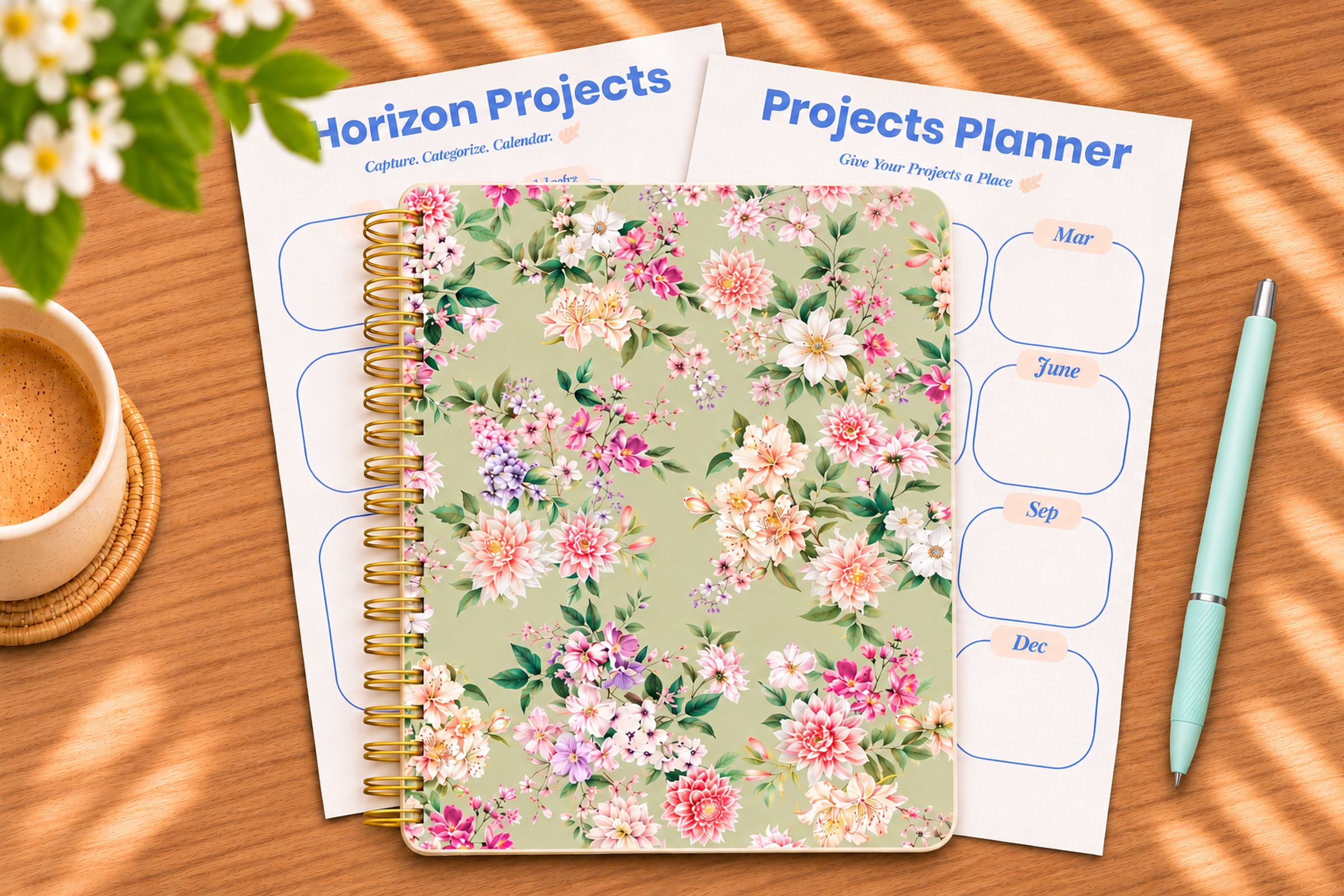
My Life Map System combines interconnected tools to help you organize your priorities and responsibilities so that you can make room for projects. Its Horizon Projects section gives you a dedicated place to capture ideas, turn them into actionable projects, and map out what you're ready to pursue over the next 12 months.
I created it to orient myself and stay on track with the things that are important to me, and I would love to share it with you.
And I hope you’ll share what kind of projects are important to you. Is there anything small that you’ve been wanting to tackle in a big way? I’d love to hear about it in the comments!
HERE’S YOUR NEXT STEP:
Find one category of information you're tired of trying to remember, and give it a reliable place to live outside your head.
Then mark your calendar for processing day!
🐦 Stay in the loop
Want to keep up with new posts from Tidy Bird? Join the email list, and I’ll let you know when there’s something new to read.