
TLDR: You don't need to squeeze more into your day.
You need to intentionally decide what your days will include, so you can get More of what you really want out of your time.
CAVEAT: Different seasons of life create different pressures, and our priorities need to be updated to match our season.
(As always, find your next step at the end!)
Let’s talk about ‘pressure’ versus ‘intention’.
Pressure comes in many different forms and therefore wears many different outfits. It could be dressed as the family member whose natural expectation is that you will attend (and help) with every single family function. It could look like the friend who assumes you should have time to be her sounding board, even when you’re in a demanding phase of your own life.
Sometimes it wears a beautiful disguise, like the adorably shimmering eyes of your precious child, asking for ‘just one more thing’ when your financial debt is creeping into your every waking thought.
It comes from many different directions, but really, those examples of pressure all come from one place.
Pressure comes from inside yourself.
Some of us put pressure on ourselves to be everything to everyone. So it doesn’t even occur to us that we’ve set up every family event for the last ten years, had way too many late night conversations with our struggling friend, or have been barely paying the minimum balance to keep our kids ‘happy’.
Some of us don’t bend as easily to social pressures, but need to admit that our inner-perfectionist pressure keeps us showing up (and spending) when we actually don’t want to.
But, wait. If we’re good people who care about our family and friends, shouldn’t we want to do everything for them?
No, and also, that’s not what this is about.
This is about Intention.
When you set intentions for what you want your life to be about, it gives you guidance on how to fill your days. It helps you navigate the endless stream of requests coming in from the outside.
Just as importantly, setting intentions about your life lets you see that your life can’t be about everything.
If you want a free weekend afternoon to work on your organization goals, you can’t also be at a family function.
If you want time to read before bed, you can’t also be engaged in a text conversation. If you want to experience the relief of getting out of debt, you can’t also buy your kids everything they ask for.
I know, this probably feels like a lot of ‘Less’.
So let’s talk about where the ‘More’ comes from!
Introducing …
Time Management (but not the boring kind).
I used to feel … let’s just say bristly when the subject of time management came up. It sounded not only starchy and corporate but, worse, it made me feel like I was being accused of something.
It made me feel like I was being accused of wasting my life by not submitting to the idea that time needs to be managed.
But somewhere along the way (specifically, when a baby entered my life and I experienced what it was like to really lose control of my time) I had a realization:
Time Management is How You Design Your Life
It isn’t about planning each hour, so you can squeeze every last drop of your energy out into your day. It isn’t about being able to control everything. And please, hear this: it isn’t about being bad at time management just because you don’t have ‘enough’ time.
Time management, when you think about it through the lens of design, is the skill of making space in your days for what you want your life to be about.
Since you already know that You Are The Architect of Your Life, let’s break down how we take the idea of time management and turn it into a Life Building Tool, working our way from the top down.
1. Design Your Days to Support Your Goals
Since you also already know that You Don’t Need Goals, You Need Next Steps, you know that a goal is a target that will almost definitely change over time.
So when we think about designing our days around something that isn’t perfectly clear, it can feel a little confusing.
I’ve found that the simplest way to move toward something that isn’t ‘set in stone’ is with what I think of as Set Time.
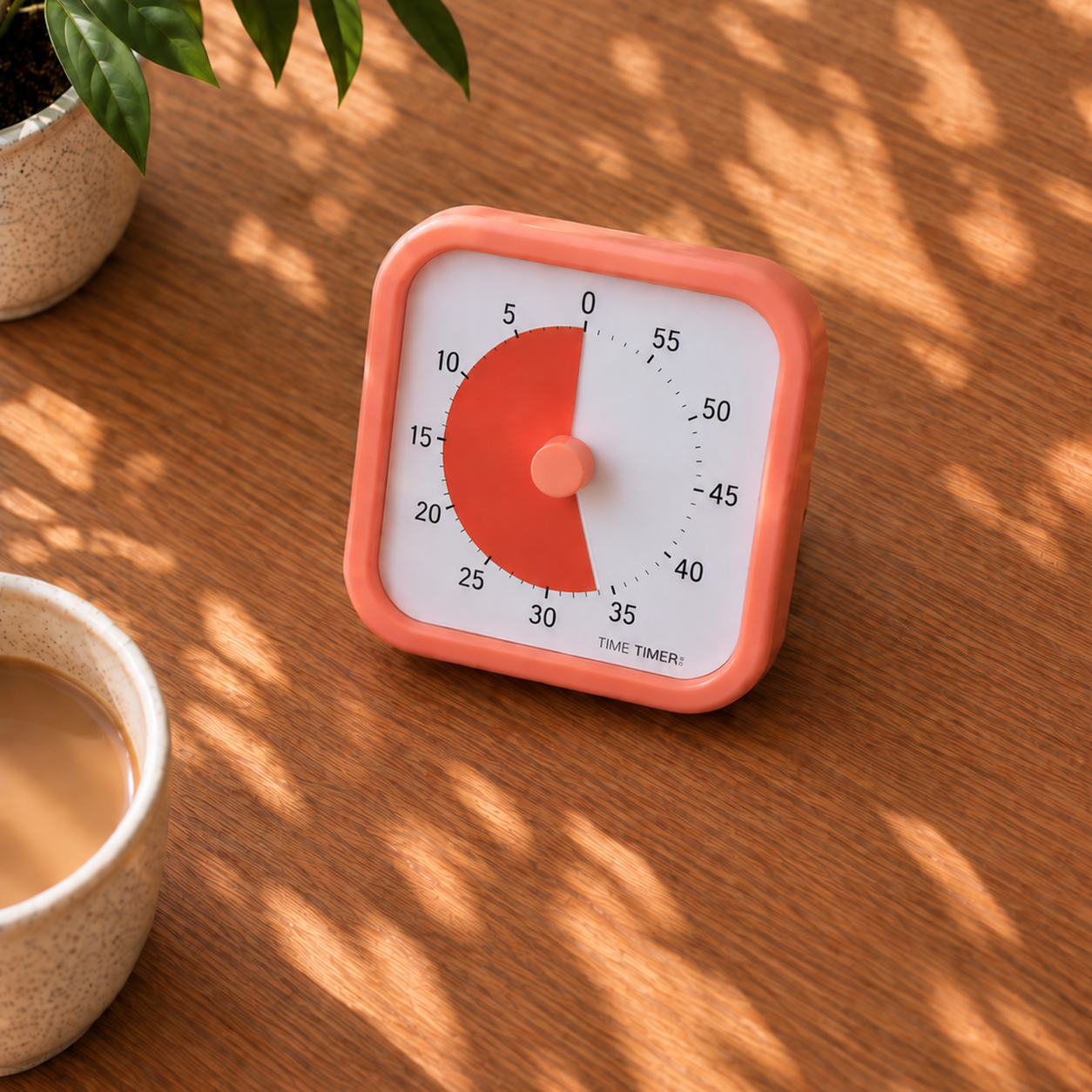
Set Time is a specific time that you ‘set aside’ for a specific thing.
The concept is simple and, once you attach it to your intentions, so is the practice.
Take any goal, regardless of its current state of clarity. Let’s say that you know you want more people in your life. You don’t yet know what that means on a practical (or even emotional) level, because you’re legitimately busy, kind of shy, and have a demanding home life.
But you know that you know it.
This is how I would use Set Time to design my day in support of that goal.
I would set the intention to create space in my day for more social interaction (for me, that means writing it down on paper). Then I would look at what’s already part of my day (work, school, errands, etx) and think about what those things mean for my intention.
Are there any opportunities that already exist? For example, is there anyone who has tried to engage me in the past? Is that something I could revisit? Or is there a community area near work/school that I could stop by on the way home?
Conversely, is there anything that prevents me from expanding my social interaction? If I’m calling the same friend on my way from the office to the car, that doesn’t leave room for anyone new to enter my life.
If I found out that actually yes, there is a lovely park five minutes from the office, then I would pick that as my easy entry point. For the next couple of weeks I would use Set Time to visit the park three days a week after work for thirty minutes to test it out as an avenue for social expansion.
The important part here is that I wouldn’t put any pressure on myself to do anything in particular at the park. Just being there regularly is enough to not only feel but to also be successful at pursuing my goal.
Social goals are tricky because they’re so dependent on other people. But that’s why they’re a great example of why Set Time is important: you can’t set aside time to make a friend—but you can set aside time to give friendship a chance to happen.
Because if you only make time for things that demand your attention, those are the things that will design your life.
Setting aside time for things you care about, whether they’re existing hobbies or expansion oriented goals, is the way that you make space for those things to actually happen.
And Set Time isn't only useful for making space for the things you want to do. It can also change the way you handle the things you have to do, so there can be space for your ‘More’, even without more time.
2. Design Your Days to Automate Recurring Tasks
Let me ask you something very directly:
Why are we treating every day like its own little emergency?
Don’t feel judged—I’ve experienced low key panic attacks over getting dinner cleaned up in time to give the baby a bath. So, truly, there can be no judgment coming from my end.
But, having experienced that, I’ve also thought about why everyday matters can reach that level of chaos.
It’s because daily activities need Set Time as much as big goals do.
And when I say “automate,” I don't necessarily mean that a machine does the work for you. I mean that you stop having to constantly renegotiate when and how the work gets done.
Also, it’s important to understand that using Set Time can help us build the habits and routines that prevent the everyday load of managing life from becoming the kind of high-level stressor that blocks personal development.
But building habits and routines takes time, so for now I want you to focus on the immediate benefit of applying Set Time to household management:
Set Time is a Container For Your Effort
And, at the risk of sounding insane, this container is kind of magic. Let me explain.
Domestic life is a wonderful gift that we’re privileged to have. Domestic life is also an endless cycle of dishes, laundry, cooking, and cleaning.
So don’t let it be.
When you create Set Time for the recurring tasks, it does two significant things:
1. It takes away the added stress of constantly remaking low-level decisions like, When will that toilet ever get cleaned?
2. It puts a boundary on how much of your life you’ll spend in maintenance mode so you’ll have time for ‘More’.
Using Set Time for recurring tasks has endless options of its own. But a few examples are:
- Designating a time on Sunday to plan meals so dinner stress is reduced to solely the physical work of procuring or creating the food
- Utilizing your washer’s ‘delay start’ feature to have the clothes ready to go into the dryer at the most convenient time of day so laundry doesn’t pile up
- Deciding that you’ll always tidy the house when you’re on the phone with your chattiest friend :)
Essentially, applying Set Time to household management means deciding ahead of time when and how the recurring tasks will get done. This lets you keep your home running as smoothly as possible with as few decisions as possible. Sometimes, it works to make your decisions as infrequently as once every few months. Other times, like the personal season I’m in now, it works better to incorporate your decisions into your weekly planning.
Either way, choose your Set Time and then don’t think about the dishes again until their time rolls around!
3. Design Your Days to Reduce The Weight of One-Offs
Here is where we have the chance to flex the true power of Set Time.
It’s one thing to book in personal time, and one thing to build a solid routine of always doing the grocery shopping on Mondays.
But what about when Life throws a bunch of unexpected things at you?
Those little one-offs are the things that can truly unravel even a well crafted schedule.
Again I find myself thinking of Parkinson’s Law, which basically says that any task will expand to fit the amount of time you give to it.
But I think the same principle applies to requests.
Someone asks you to do something, and because it doesn't have a natural place in your schedule, you start rearranging your life to accommodate it.
You answer the email immediately. You make the phone call right away. You squeeze in the errand on your way home. You spend an entire afternoon helping with something that you thought would take twenty minutes.
Set Time gives these one-offs a boundary.
You don’t have to say no to everything (although I would advocate for you to say no More often ;) You can say yes to something without giving it unlimited access to your time.
You can run that errand on Thursday afternoon. You can clearly state that you’d love to help for one hour. You could try batching several little requests together and deal with them all at once.
The point isn't to become a rigid, unhelpful person.
It's to stop letting every new request redesign your day.
Ultimately, Set Time is about deciding which activities actually deserve to be in your life, and then giving them a place in your days.
Whether it’s the regular effort required for whatever type of home you want to create, or not cheating yourself out of the actual experience of living, you can use Set Time to keep daily demands from crowding the important things out.
You don’t need More time—you just need to be intentional with the time you already have.
HERE’S YOUR NEXT STEP:
Choose one recurring task that regularly takes up too much space in your brain and too much time on your clock and give it a Set Time.
Pick a time that is the most conducive to doing the task with minimal stress, and put it on your calendar (with a reminder alert set!)
P.S. If you need a little help designing your week, an overview can work wonders. Join The Systems Library to get my free Weekly Planner sheet.