
TLDR: Planning is a skill, not a talent you’re born with or without. Whatever your natural strengths or challenges, the right system can help you develop your planning abilities. And that can help you live a more intentional life.
CAVEAT: Your planning system needs to work with your brain.
(As always, find your next step at the end!)
Last week, I wrote about why you need a Plan B.
But … what if you don’t even have a Plan A?
The idea of planning sounds simple, and yet so many of us don’t actually know how to do it. And that’s no insult to our intelligence. I’ve spent my life planning in different capacities and I personally feel it’s only in the last few years that I’ve really grasped what a planning practice truly is.
First, it’s important to understand that there’s a difference between planning an event and planning a timeframe.
For instance, planning a large wedding involves a massive number of details that need to be considered and therefore deserves detailed planning. But once the wedding happens, the plan is complete.
Planning your fall season, while maybe not as intricate as a two hundred person wedding, involves detailed and dynamic planning.
The key difference is this:
An event is something you plan and execute. A timeframe is something you plan and actively live through.
If you’ve read my origin story post, you know that when I finally experienced the difference between these two planning skill sets, my life changed.
That’s what I want for you, too.
That’s why we’re going to get into the dynamic details of how to (actually) make a plan.
How To (Actually) Plan Your Week
Planning your week is a perfect way to learn to plan a timeframe. Looking at your entire week at once gives you a few significant opportunities. It:
Involves a range of variables to think through
Lets you practice adaptability with enough space to move things around if need be
Gives you a chance to accomplish what matters, even when a day doesn’t go as planned
And, very importantly, creating an overview of your week gives you a realistic idea of the time you actually have. This fact-based approach might sound a little … boring at first, but I promise that it can actually open up your planning practice to support your bigger dreams.
Before we get into the actual method, there’s a second important distinction that needs to made:
There’s a difference between making a list and making a plan.
We all know lists—they’re so very useful and yet, somehow they can also be very paralyzing. I’ve noticed that it’s not always a matter of size either. Sometimes even a short list can make me stall out.
I believe it’s because a list on its own is all “I have to do it” and no “this is how it will get done.”
My old lists weren’t bad, and I bet yours aren’t either. But the problem with a list is that even when it’s “organized” it doesn’t take into account the kind of details that make action possible.
For example, your random-Tuesday list might include things like: clean bathroom, get gift for party, research business idea, take kid to soccer game, make dinner.
That doesn’t sound like too much to accomplish in one day … until you try to make it happen with no action plan.
How will you fit cleaning the bathroom in between shopping for the gift? What about that idea you’ve been aching to develop? Do you even know where to begin doing your research? And how will you make dinner when the soccer game doesn’t end until 7pm?
These are not judgments. They’re questions.
And asking them is how you (actually) make a plan.
A 3-Step Approach to Weekly Planning
The act of planning can get intricate, especially if it’s something you enjoy just for the sake of it (said the Planning Dork). But it definitely doesn’t have to be complex, and it doesn’t even have to take a lot of time.
In fact, taking the simplest route is the best way to build consistency because it creates the least friction between you and the habit you’re developing.
Here’s my simple approach to weekly planning, which I’ll explain in detail below:
Do a Brain Dump
Fill in your Hardscape
Plan your Projects
When you sit down to make your plan, you only need a few things:
Your ‘information’ sources, such as your phone, calendar, computer, paper planner, physical mail
Your Brain Dump
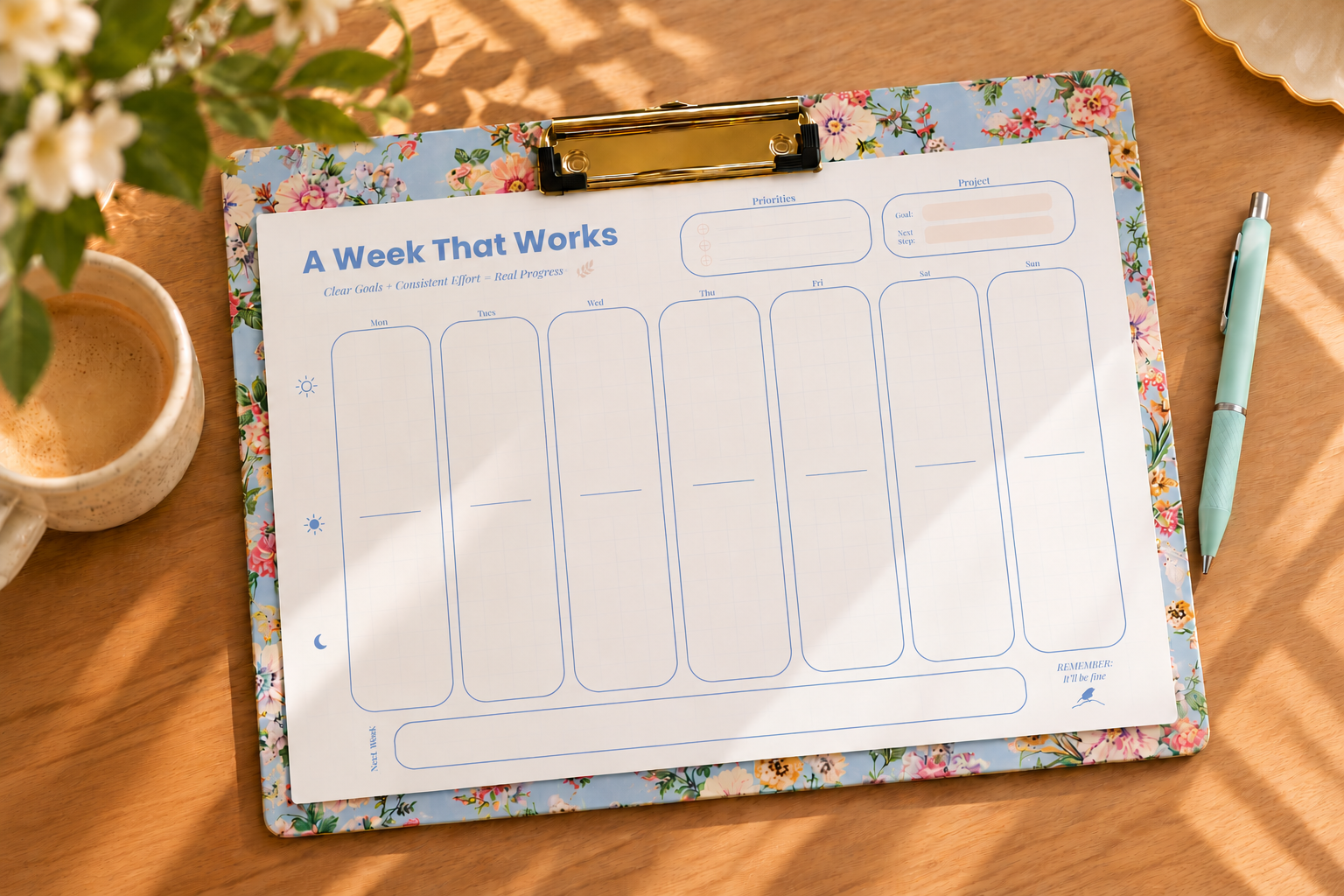
Your weekly overview sheet (get your free printable here)
You can choose to start your week at any time—the goal is getting a handle on your next seven days. Personally, I do Sunday planning because I have a little more personal space available on Sundays and, even without a 9-5, I’ve always felt like my week begins on Monday.
Choose your planning day according to what’s best for you.
1. Do a Brain Dump, Not a List
I’m not sure when Brain Dumps became so popularly talked about, but once I started utilizing them instead of lists, I became way more productive.
At first glance, they look like the same thing. But there’s an incredibly useful feature of a Brain Dump that a regular old list just doesn’t have: they work better to relieve the pressure in your mind.
I believe this is because a Brain Dump is meant to be just that—a complete dumping out of all the things swirling around in your head. Not just the task list, but also the mental stuff.
They’re kind of like if a list and a journal had a baby.
They combine the utilitarian aspects of a list (collecting tasks) and the mental relief of journaling (collecting worries). And seeing all those things together can help you when it’s time to prioritize everything you’re about to process.
Processing + Prioritizing = Planning
So if you’ve listed a bunch of tasks related to cleaning your house, but your Brain Dump also includes things like Spend More Time with Family or Check in on Best Friend, then you know that this week, the toilets simply don’t need to sparkle.
2. Determine your ‘Hardscape’
Working with the reality of your available time is the best gift you can give yourself when it comes to planning. Sure, at first you might only see the giant portions of your days that are allotted to your 9-5, or the chunks ‘lost’ to your commute.
But you need to see your hardscape in order to see beyond it. And then you’re able to see potential.
First, check your calendars, texts, emails, and any other place that might have information about events that you’ve scheduled.
Next, fill in the hours during your week that are already spoken for: your work schedule, any pre-set appointments/commitments, and the time you spend on the road driving to and from these things.
3. Plan your Projects
This is the best part. This is the part where the potential lies.
Before we get into the method, let’s go back to your random-Tuesday example.
In that scenario, your list included cleaning the bathroom, shopping for a gift, researching a business idea, and making sure people eat dinner in spite of an evening soccer game.
In your weekly planning scenario, your Brain Dump took into account all the other things going on in your week (and your mind). So you might plan those things in like this:
Sun. pm—clean the bathroom before showering
Mon. lunch—identify 3 research sources for business idea
Mon. pm—defrost casserole for tomorrow, purchase gift online
Tues. am—listen to business podcast on commute
Tues. lunch—spend 30 minutes on business research
Tues. pm —attend soccer game, dinner at 7:30
And if Tuesday’s business podcast doesn’t happen because a valued friend calls with an important question? You can move that listening block to your next commute, or maybe add it in while you cook dinner on Thursday.
This is an example of how looking at your week as one entity, rather than seven individual days, gives you the opportunity to make the best use of your available time without abandoning your goals to the general business of Life.
This way, you’re not asking yourself to magically create extra hours in the day so you can move your goals and projects forward while still meeting your basic needs.
You don’t need a different life. You need a different plan.
By looking at your week as a whole, you’re able to see where time does exist. And that’s where the potential for growth lies. By the end of a week like the example above, you could have excelled at managing your home, met your people’s needs, and invested several hours into your own personal development.
What did you do last week?
In addition to the life-changing productivity boost that I experienced when I started my weekly planning practice, I found something equally valuable: the act of planning itself can be a soothing self-care practice.
In our media-saturated lives, there’s something extra calming about engaging in an analog activity like paper-and-pen planning. And there’s also something a little less trending about it:
When you intentionally create time for your planning practice, you’re making a vote for your self-worth.
You’re subconsciously saying to yourself, My life is busy and full of responsibilities to others. But my time matters, too.
HERE’S YOUR NEXT STEP:
Plan your next week, and notice what changes when you stop figuring everything out as you go.
P.S. If you want a ready-made weekly overview sheet, join my free Systems Library by clicking here.